THE HUMAN
1. The Human
While everyone starts with the machine, we start with the human.
How can we expand human flourishing in the age of AI? How can we reverse
engineer the brain's extraordinary capacities? What can wisdom traditions teach
us about how to build safe superintelligence?
Just as neural networks inspired modern AI architectures, we believe that the
human body and mind hold further untapped innovations, unlocking intelligence,
adaptability, evolution, flourishing, and maybe even consciousness itself.
By conducting multiscale and cross-substrate research at the intersection of
neuroscience, computation, physics, consciousness and contemplative wisdom,
we aim to understand the full spectrum of human experience, enabling safer and
more efficient technologies.
THE INTERFACE
2. The Interface
Current human-machine interfaces rely primarily on language and chatbots. Our
approach is different.
Just as our bodies seamlessly connect us with the world, each other, and nature,
we aim to develop new holistic, embodied interfaces that leverage our innate and
effortless communication channels, creating more organic and human-centred
connections with AI.
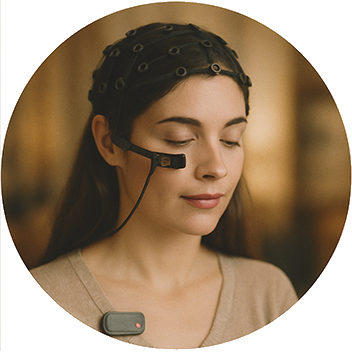
Our research also tackles the most overlooked bottleneck in brain-computer
interfaces: the signal-to-noise ratio of our brains.
Human experience is filled with noise, including thoughts and distractions that
can mask our true intentions. Research shows that meditation may hold the
solution to this problem, by stabilizing attention, reducing mind-wandering, and
sharpening sensory and interoceptive perception.
THE AI
3. The Artificial Intelligence
The human brain needs ~20 W of power (similar to a dim light bulb) compared to
state-of-the-art AI that consumes megawatts and achieves less.
Our research aims to reverse-engineer the brain's remarkable computational
efficiency, highly distributed architecture and capacity for compression across
multiple scales. By doing so, we can unlock biomimetic AI architectures that use
dramatically less power yet achieve greater intelligence.
Yet our goal is not just efficiency, but alignment with human flourishing. Inspired
by the human brain and ancient contemplative traditions, we aim to move
beyond superficial rules and towards self-reinforcing alignment solutions that
cultivate intrinsic wisdom and compassion.